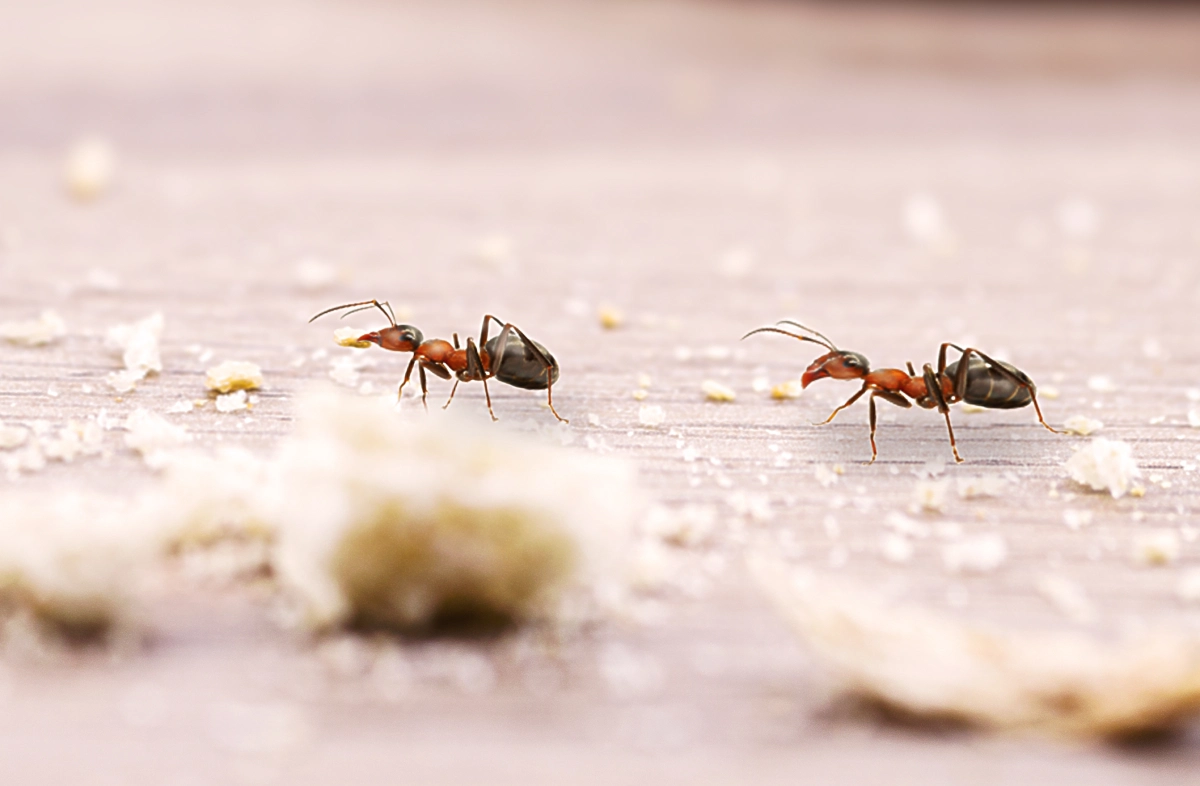
CARPENTER ANTS
Of all the ant species found in Sussex County and Morris County, New Jersey, carpenter ants are the ones that demand the most urgent attention. They are the largest common ant you are likely to encounter in your home — sometimes half an inch long — and their presence inside your walls is not just a nuisance. An established carpenter ant colony signals a moisture problem, threatens the structural integrity of wood components in your home, and will not resolve on its own without targeted professional treatment.
What Carpenter Ants Actually Are
Carpenter ants belong to the genus Camponotus and are most commonly black in New Jersey, though some species are reddish-black or bicolored. Their most distinguishing features are their large size, a distinctly rounded thorax when viewed from the side, and elbowed antennae. Unlike termites, which are sometimes confused with carpenter ants during swarming season, carpenter ants have a pinched waist and — if winged — front wings noticeably larger than their rear wings. They are nocturnal and most active at night, which is why homeowners sometimes find them in their kitchen after dark without realizing the extent of the colony inside their walls.
They Do Not Eat Wood — They Excavate It
A common misconception is that carpenter ants eat wood the way termites do. They do not. Carpenter ants excavate galleries inside wood to create smooth, clean chambers for nesting and raising larvae. The sawdust-like material they push out — called frass — is a mixture of wood shavings, soil, dead ants, and insect parts. Finding frass near a baseboard, window frame, or door jamb is one of the most reliable indicators of an active carpenter ant nest inside your home’s structure. The galleries they create weaken load-bearing wood components over time.
What They Damage in Sussex County Homes
Carpenter ants strongly prefer wood that has been softened by moisture. In Sussex County homes, this means they are commonly found nesting in wood near roof leaks, in window frames exposed to rain, beneath decks that hold moisture, in crawl spaces, and in basements where humidity is high. They can also nest in dry wood, particularly in older homes with established satellite colonies. Structural timbers, subflooring, wall framing around plumbing, and wood trim are all susceptible. Because their galleries follow the grain of the wood, extensive damage can accumulate before it is externally visible. A home with a long-standing carpenter ant infestation may have wood that appears intact from the outside but is significantly hollowed within.
Why DIY Treatment Rarely Works
Over-the-counter sprays applied where carpenter ants are visible kill surface workers but do not reach the colony, which is typically deep inside a wall void, beneath insulation, or in the subfloor. Carpenter ant colonies also maintain satellite nests — smaller secondary nests, sometimes without a queen — connected to the main parent colony. Treating one access point may simply redirect foraging activity to a different part of your home. Professional treatment involves injecting insecticide dust directly into identified gallery locations, applying bait along foraging trails, and addressing the moisture conditions that originally attracted the colony.
The Moisture Connection
Because carpenter ants are so strongly associated with water-damaged wood, their presence inside your home is frequently a diagnostic indicator of a moisture problem you may not yet be aware of. A roof leak, a slow plumbing drip inside a wall, inadequate crawl space ventilation, or a compromised deck board can all create the conditions carpenter ants seek. Resolving the infestation without addressing the moisture source provides only temporary relief. Bustabug Pest Control’s inspection process includes assessment of the conditions contributing to carpenter ant activity, not just treatment of the ants themselves.
Frequently Asked Questions
Q: How do I know if I have carpenter ants or termites?
A: Carpenter ants are large, black, and have a pinched waist, elbowed antennae, and (if winged) unequal wing sizes. Termites are smaller, pale, have a thick waist, straight antennae, and equal-sized wings. The frass left by carpenter ants is coarse and fibrous; termite frass (drywood termite pellets) is tiny and pellet-shaped. When in doubt, a professional inspection is the fastest way to confirm.
Q: Can carpenter ants cause serious structural damage to my home?
A: Yes. While damage occurs more slowly than with termites, a large or long-established carpenter ant colony can significantly compromise the structural integrity of affected wood. Subflooring, wall framing, and roof decking are all vulnerable. Early detection and treatment are far less costly than structural remediation after extensive gallery excavation.
Q: What time of year are carpenter ants most active in New Jersey?
A: Carpenter ants are most visible in spring, when overwintered colonies become active and swarmers emerge to establish new nests. Foraging activity continues through summer and into fall. If you are seeing large black ants inside your home in spring or summer, scheduling a professional inspection before peak season is strongly advised.
Contact Us Today
Ants can multiply quickly and cause contamination issues in a home. Protect your home and family with experienced pest control from Bustabug Pest Control. Have questions about our process? Need assistance with a pest problem? We’re here to help. Schedule an inspection today. Fill out the online form, call (973) 721-9197, or send an email to bustabugpestcontrol@gmail.com.
PEST SERVICES
TESTIMONIALS
Jonathan
One of the best companies in the area! I had a big issue in the house, and Rob was able to handle it in a timely manner. He did not mind answering all the questions My wife and I had. He answered them in professionally and respectfully manner. Very reasonable in price. I highly recommend them to anybody that’s looking to get rid of any type of Pest Control issue.